
Some selected publications
The influence of the Miocene Mediterranean desiccation on the geographical expansion and genetic variation of Androcymbium gramineum (Cav.) McBride (Colchicaceae)
Caujapé-Castells J, Jansen RK
Molecular Ecology 12: 1515–1525 (2003)
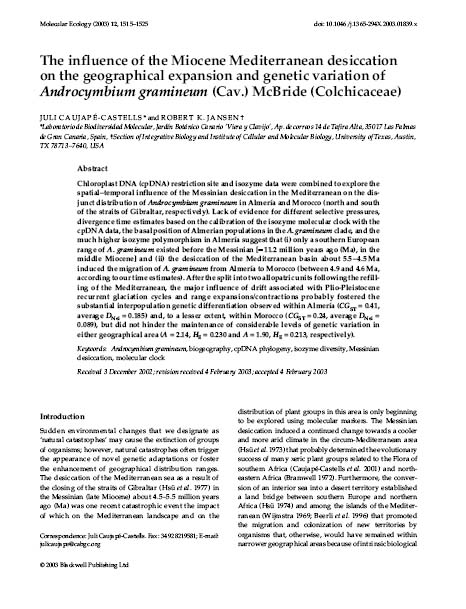
Chloroplast DNA (cpDNA) restriction site and isozyme data were combined to explore the spatial–temporal influence of the Messinian desiccation in the Mediterranean on the disjunct distribution of Androcymbium gramineum in Almería and Morocco (north and south of the straits of Gibraltar, respectively). Lack of evidence for different selective pressures, divergence time estimates based on the calibration of the isozyme molecular clock with the cpDNA data, the basal position of Almerian populations in the A. gramineum clade, and the much higher isozyme polymorphism in Almería suggest that (i) only a southern Europeanrange of A. gramineum existed before the Messinian [≈11.2 million years ago (Ma), in the middle Miocene] and (ii) the desiccation of the Mediterranean basin about 5.5–4.5 Ma induced the migration of A. gramineum from Almería to Morocco (between 4.9 and 4.6 Ma,according to our time estimates). After the split into two allopatric units following the refilling of the Mediterranean, the major influence of drift associated with Plio-Pleistocene recurrent glaciation cycles and range expansions/contractions probably fostered the substantial interpopulation genetic differentiation observed within Almería (CGST= 0.41, average DNei = 0.185) and, to a lesser extent, within Morocco (CGST= 0.24, average DNei=0.089), but did not hinder the maintenance of considerable levels of genetic variation ineither geographical area (A = 2.14, He= 0.230 and A = 1.90, He= 0.213, respectively).
Aspectos filosóficos del análisis de datos en sietemática molecular
Caujapé-Castells J, Pedrola-Monfort J, Membrives N
Botánica Macaronésica 24: 127–141 (2003)
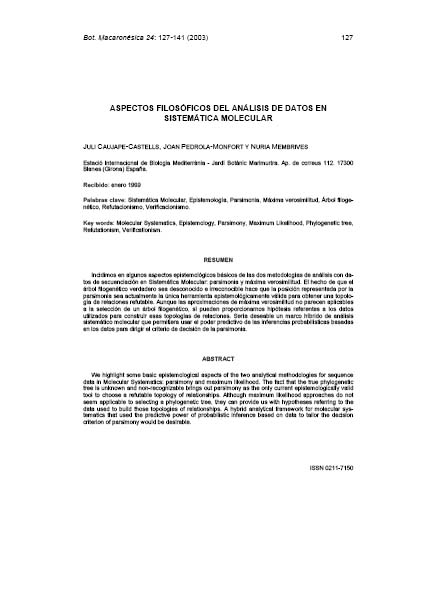 Incidimos en algunos aspectos epistemológicos básicos de las dos metodologías de análisis con da-tos de secuenciación en Sistemática Molecular: parsimonia y máxima verosimilitud. El hecho de que el árbol filogenético verdadero sea desconocido e irreconocible hace que la posición representada por la parsimonia sea actualmente la única herramienta epistemológicamente válida para obtener una topolo-gía de relaciones refutable. Aunque las aproximaciones de máxima verosimilitud no parecen aplicables a la selección de un árbol filogenético, sí pueden proporcionarnos hipótesis referentes a los datos utilizados para construir esas topologías de relaciones. Sería deseable un marco híbrido de análisis sistemático molecular que permitiera usar el poder predictivo de las inferencias probabilísticas basadas en los datos para dirigir el criterio de decisión de la parsimonia.
We highlight some basic epistemological aspects of the two analytical methodologies for sequence data in Molecular Systematics: parsimony and maximum likelihood. The fact that the true phylogenetic tree is unknown and non-recognizable brings out parsimony as the only current epistemologically valid tool to choose a refutable topology of relationships. Although maximum likelihood approaches do not seem applicable to selecting a phylogenetic tree, they can provide us with hypotheses referring to the data used to build those topologies of relationships. A hybrid analytical framework for molecular systematics that used the predictive power of probabilistic inference based on data to tailor the decision criterion of parsimony would be desirable.
Space-time diversification of Androcymbium Willd. (Colchicaceae) in western South Africa
Caujapé-Castells J, Jansen RK, Pedrola-Monfort J, Membrives N
Plant Systematics and Evolution 232: 73–88 (2002)
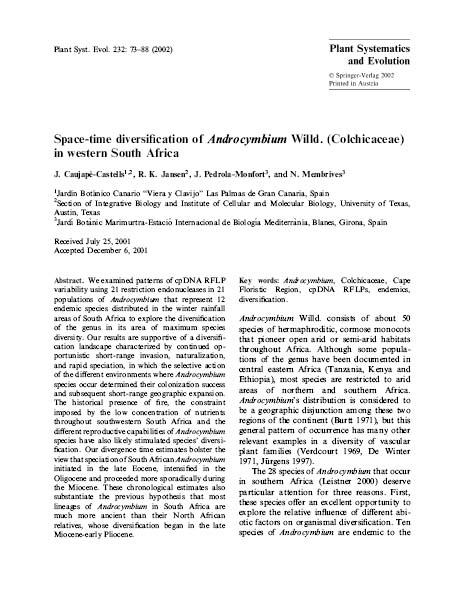 We examined patterns of cpDNA RFLP variability using 21 restriction endonucleases in 21 populations of Androcymbium that represent 12 endemic species distributed in the winter rainfall areas of South Africa to explore the diversification of the genus in its area of maximum species diversity. Our results are supportive of a diversification landscape characterized by continued opportunistic short-range invasion, naturalization, and rapid speciation, in which the selective action of the different environments where Androcymbium species occur determined their colonization success and subsequent short-range geographic expansion. The historical presence of fire, the constraint imposed by the low concentration of nutrients throughout southwestern South Africa and the different reproductive capabilities of Androcymbium species have also likely stimulated species’ diversification. Our divergence time estimates bolster theview that speciation of South African Androcymbium initiated in the late Eocene, intensified in the Oligocene and proceeded more sporadically during the Miocene. These chronological estimates alsosubstantiate the previous hypothesis that most lineages of Androcymbium in South Africa are much more ancient than their North African relatives, whose diversification began in the late Miocene-early Pliocene.
Historical biogeography of Androcymbiurn Willd. (Colchicaceae) in Africa: evidence from cpDNA RFLPs
Caujapé-Castells J, Jansen RK, Membrives N, Pedrola-Monfort J, Montserrat JM, Ardanuy A
Botanical Journal of the Linnean Society 136: 379-392 (2001)
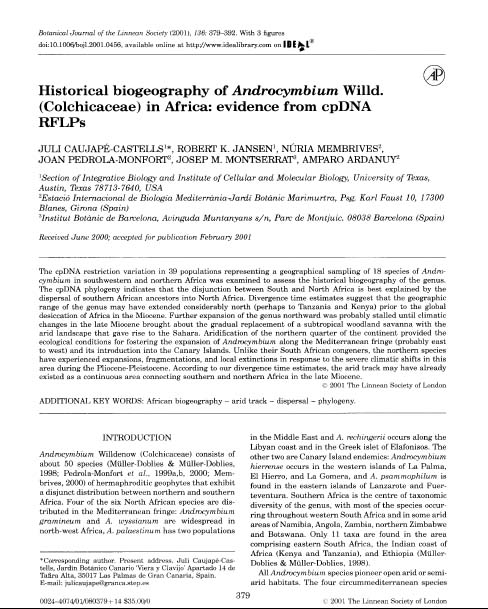 The cpDNA restriction variation in 39 populations representing a geographical sampling of 18 species of Androcymbium in southwestern and northern Africa was examined to assess the historical biogeography of the genus. The cpDNA phylogeny indicates that the disjunction between South and North Africa is best explained by the dispersal of southern African ancestors into North Africa. Divergence time estimates suggest that the geographic range of the genus may have extended considerably north (perhaps to Tanzania and Kenya) prior to the global desiccation of Africa in the Miocene. Further expansion of the genus northward was probably stalled until climatic changes in the late Miocene brought about the gradual replacement of a subtropical woodland savanna with the arid landscape that gave rise to the Sahara. Aridification of the northern quarter of the continent provided the ecological conditions for fostering the expansion of Androcymbium along the Mediterranean fringe (probably east to west) and its introduction into the Canary Islands. Unlike their South African congeners, the northern species have experienced expansions, fragmentations, and local extinctions in response to the severe climatic shifts in thisarea during the Pliocene-Pleistocene. According to our divergence time estimates, the arid track may have already existed as a continuous area connecting southern and northern Africa in the late Miocene.
Leaf morphology and anatomy of genus Androcymbium (Colchicaceae) in Southwest Africa
Membrives N, Pedrola-Monfort J, Caujapé-Castells J
Collectanea Botanica 26: 83–99 (2003)
 Morphological and anatomical leaf studics were made in 32 populations belonging to 17 taxa of the genus Androcymbium in Southwest Africa. Thc morphological characters studied were corm and tunic characteristics, and number, distribution, shape, size, section, and color of leaves and bracts. The micromorphological characters were the leaf ¡ndument on both surface and margin, shape and size of epidermic cells, type and amoumt of stomata. Finally, the anatomical characters were mesophyll cell types, epidermic cell sizes, cellular wall types, size of central epidermic cells related to the other epidermic cells, and amount of idioblasts. The results showed a great heterogeneity in almost all characters analyzed. However, macromorphological characteristics related to color and shape of leaves and bracts in the genus Androcymbium could be used as indicators of taxonomic affinities among species. Conversely, thc micromorphological and anatomical characteristics studied showed a great variation of types that does not agree with the inter-specific relationships established from morphological, allozymatic or cpDNA RFLP data in other research carried out within the genus