
Some selected publications
Barcodes of Garajonay flora
La flora endémica del Parque Nacional de Garajonay bajo la perspectiva molecular: las secuencias de ADN como herramienta en la identificación taxonómica
Jaén-Molina R, Marrero-Rodríguez Á, Reyes-Betancort JA, Naranjo-Suárez J, Santos-Guerra A, Caujapé-Castells J (Angiosperms) & Werner O, Patiño J, González-Mancebo JM, Draper I, Ros, RM (Briophytes)
Pp. 249-273 In Naturaleza y Parques Nacionales. Serie Investigación en la red, Ramírez-Sanz L and Asensio-Nistal B (eds.). Ministerio de Medio Ambiente y Medio Rural y Marino, Madrid (2010)
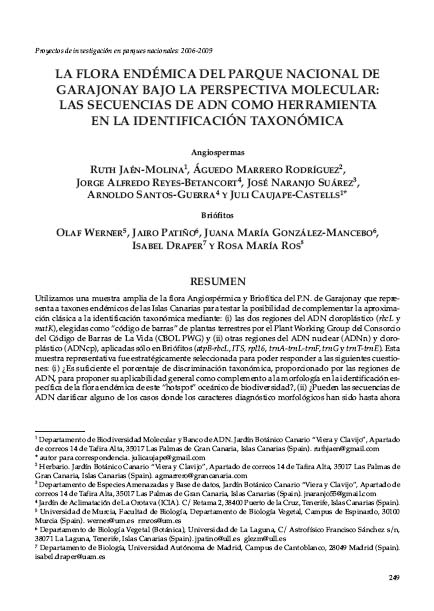
We tested the feasibility of complementing classical taxonomy with the information contained in: (i) the two chloroplast DNA regions (rbcL and matK) proposed by the Plant Working Group of the Consortium for the Barcode of Life (CBOL) as “DNA barcodes” for plants, and (ii) other regions of nuclear and chloroplast DNA, only in Bryophytes (atpB-rbcL, ITS, rpl16, trnA-trnL-trnF, trnG and trnT-trnE) using a broad sampling of the Angiospermic and Bryophytic flora at the N.P. of Garajonay (Canary Islands). These sampleswere strategically chosen to answer the following questions: (i) Is the percentage of taxonomic discrimination success provided by the DNA regions enough to propose its widespread applicability, as a complement to morphology, in the species ID of the endemic flora of this oceanic insular hotspot?, (ii) May the DNA sequences shed light on cases where morphological diagnosis has been elusive or conflictive?, and (iii) Does molecular information suggest the existence of cryptic species overlooked by morphology? In both biological groups assessed, the success of the molecular approach to species identification is beyond sufficiency for taxonomically clear cases; however, in Bryophytes, the two CBOL´s cpDNA regions are not applicable for various reasons, and we opted to use the above-mentioned cpDNA regions (either alone, or in ad hoc combinations). The molecular approach also made it possible to provide resolution to some conflictive cases in both groups, and to elicit discrepancies with classical taxonomy that support hypotheses of cryptic species. Other important insights for the continuity of the morphological-molecular approach to the taxonomy of the Canarian flora are: (i) the necessity of using other DNA regions for the taxonomic characterization of the Bryophytes, (ii) the suitability of only a character-based discrimination criterion for Angiosperms, and (iii) the much higher success of matK in discriminating taxonomically conflictive Angiosperms, despite major technical hurdles encountered in the amplification of this region. We believe that these results pave the way to the construction of a morphological-molecular taxonomic catalogue of the endemic Angiosperms and Bryophytes at Garajonay National Park, and to estimate Phylogenetic Diversity of the Canarian Flora with systematic and conservation outlooks.
Conservation of oceanic island floras
Conservation of oceanic island floras: Present and future global challenges
Caujapé-Castells J, Tye A, Crawford DJ, Santos-Guerra A, Sakai A, Beaver K, Lobin W, Florens FBV, Moura M, Jardim R, Gómes l, Kueffer C
Perspectives in Plant Ecology Evolution and Systematics 12: 107-129 (2010)
 Current threats to the planet’s biodiversity are unprecedented, and they particularly imperil insular floras. In this investigation, we use the threat factors identified by the Millennium Ecosystem Assessment as the main drivers of biodiversity loss on islands to define and rank 13 current, continuing threats to the plant diversity of nine focal archipelagos where volcanic origin (or in the Seychelles a prolonged isolation after a continental origin) has produced a high degree of endemicity and fragility in the face of habitat alteration. We also conduct a global endangerment assessment based on the numbers of insular endemic plants in the endangered (EN) and critically endangered (CR) IUCN categories for 53 island groups with an estimated 9951 endemic plant species, providing a representative sample of the world’s insular systems and their floristic richness. Our analyses indicate that isolation does not significantly influence endangerment, but plant endemics from very small islands are more often critically endangered. We estimate that between 3500 and 6800 of the estimated 70,000 insular endemic plant species worldwide might be highly threatened (CR+EN) and between ca. 2000 and 2800 of them in critical danger of extinction (CR). Based on these analyses, and on a worldwide literature review of the biological threat factors considered, we identify challenging questions for conservation research, asking (i) what are the most urgent priorities for the conservation of insular species and floras, and (ii) with the knowledge and assets available, how can we improve the impact of conservation science and practice on the preservation of island biodiversity? Our analysis indicates that the synergistic action of many threat factors can induce major ecological disturbances, leading to multiple extinctions. We review weaknesses and strengths in conservation research and management in the nine focal archipelagos, and highlight the urgent need for conservation scientists to share knowledge and expertise, identify and discuss common challenges, and formulate multi- disciplinary conservation objectives for insular plant endemics worldwide. To our knowledge, this is the most up-to-date and comprehensive survey yet to review the threat factors to native plants on oceanic islands and define priority research questions
General GST and q inflation
Caujapé-Castells J
Conservation Genetics 11: 709-720 (2010)
 While knowledge of the degree of inter-population genetic differentiation underlies the understanding of micro-evolutionary processes in any organism, its calculation through GST, FST, or θ (which, unlike the previous two, was designed to correct for unequal and small sample sizes) is often based in severely restricted intra-population samples, which are nonetheless tacitly assumed adequate to their accurate estimation. Empirical assessment of the influence of the number and intra-population distribution of samples on the values of GST and θ for several Canarian endemic plants compellingly suggests that (1) contrary to expectations based on simulated datasets, θ does not account for empirical sampling bias better than GST; (2) sample sizes being equal, collections scattered across each population’s occupancy area entail significantly lower over-estimates of GST and θ than if they only consider one of the population extremes, especially in narrow allogamous taxa with small populations; (3) in small samples, a scattered sampling strategy is significantly less sensitive to GST inflation than sampling in one of the population extremes; and (4) a software-related component of bias should be considered when pooling values of GST from different studies to calculate averages. Thus, unlike the sampling methods used for many plant endemics from the Canaries and other regions, collections for a reliable estimation of inter-population differentiation using molecular markers should encompass the whole occupancy area of each population, and include a higher proportion of individuals respect to the total size in narrow endemics than in widespread congeners. Critically, the high average allozyme inter-population differentiation reported for the Canarian endemic Flora is possibly an over-estimate, and could be explained predominantly by the generally biased intrapopulation sampling associated with GST estimates, rather than by specific factors of insularity that restrict gene flow radically, as it has been hitherto assumed.
Plant conservation
The status of plant conservation on the Macaronesian archipelagos
Caujapé-Castells J, Santos-Guerra A, Jardim R, Gouveia L, Melo J, Rodrigues NP, Bramwell D, Gómes I
4th Global Botanic Gardens Congress Book: 1-10. IUCN editions, London (2010)
 We assess the threats to the endemic plant diversity on the Macaronesian oceanic insular hotspot, consisting of five Atlantic archipelagos where heterogeneous biogeographical, historical and political characteristics have determined contrasting conservation priorities. A recent review identified invasive alien plants and vertebrates, small population sizes and fragmentation, and demographic and economic growth as the main overall drivers of plant diversity loss in this area. Cogent with deficiencies detected on basic reproductive biology knowledge, taxonomy, and implementation of scientifically streamlined in situ conservation strategies (including management of invasives), priority actions to be undertaken by the botanic gardens in this region should include (i) to foster multi-disciplinary research collaboration aimed at filling those knowledge gaps, (ii) to monitor the possible effects of environmental shifts on plant diversity, and (iii) to increase interaction between policy makers and researchers through applying the resulting information. Ex situ conservation is a major priority for all the endemic floras; consequently, the already existing herbaria, seed banks and DNA banks should receive better institutional support. An international network of island plant conservationists would be a major milestone to share knowledge and expertise with other insular areas of the world facing similar challenges, and to better address urgent conservation needs