
Some selected publications
El banco de ADN de la flora canaria: creación, progresos y líneas futuras de desarrollo
Caujapé-Castells J, Jaén-Molina R, Cabrera-García N
Botánica Macaronesica 26: 3-16 (2006)
 The Jardín Botánico Canario “Viera y Clavijo” (JBCVC) coordinated the project “BIOMABANC: Biodiversity banks of the Macaronesian Flora”, in which the University of Las Palmas de Gran Canaria, the Jardim Botanico da Madeira and the Universidade dos Açores participated as stakeholders and collaborators. This project was approved in 2004 and was funded by the program of communitary initiative INTERREG IIIB Açores-Madeira-Canarias 2000-2006. Among other important lines of action, the JBCVC was responsible for setting up a DNA bank of natural populations of Macaronesian plants, with a special focus in the representation of Canarian endemics and of phylogenetically related taxa that are distributed in mainland or insular regions that bear Floristic links with Macaronesia. We set forth the organisation and philosophy of our DNA bank and offer the first data describing ongoing progresss and the future lines of action that are already being implemented.
Genetic differentiation of three species of Matthiola (Brassicaceae) in the Sicilian insular system
Sánchez JL, Domina G, Caujapé-Castells J
Plant Systematics and Evolution 253: 81–93 (2005)
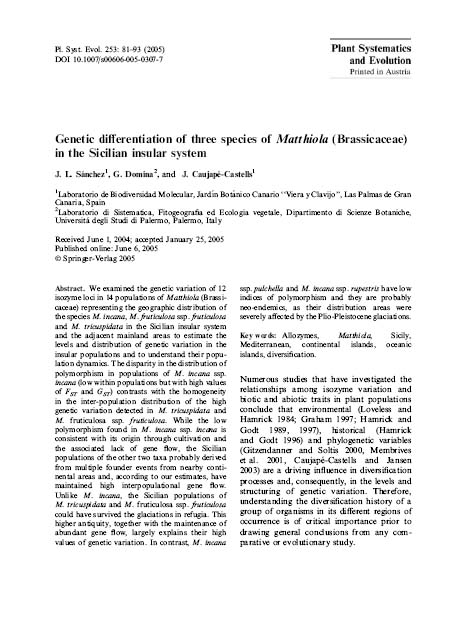
We examined the genetic variation of 12 isozyme loci in 14 populations of Matthiola (Brassicaceae) representing the geographic distribution of the species M. incana, M. fruticulosa ssp. and M. tricuspidata in the Sicilian insular systemand the adjacent mainland areas to estimate thelevels and distribution of genetic variation in the insular populations and to understand their population dynamics. The disparity in the distribution of polymorphism in populations of M. incana ssp. incana (low within populations but with high values of FST and GST) contrasts with the homogeneity in the inter-population distribution of the high genetic variation detected in M. tricuspidata and M. fruticulosa ssp. fruticulosa. While the low polymorphism found in M. incana ssp. incana is consistent with its origin through cultivation and the associated lack of gene flow, the Sicilian populations of the other two taxa probably derived from multiple founder events from nearby continental areas and, according to our estimates, have maintained high interpopulational gene flow. Unlike M. incana, the Sicilian populations of M. tricuspidata and M. fruticulosa ssp. fruticulosa could have survived the glaciations in refugia. This higher antiquity, together with the maintenance ofabundant gene flow, largely explains their highvalues of genetic variation. In contrast, M. incana ssp. pulchella and M. incana ssp. rupestris have low indices of polymorphism and they are probably neo-endemics, as their distribution areas were severely affected by the Plio-Pleistocene glaciations
Diversidad genética en Parolinia: P. glabriuscula y P. platypetala (Brassicaceae: Matthioleae)
Fernández-Palacios O, Pérez de Paz J, Febles R, Caujapé-Castells J
Botánica Macaronésica 25: 143-160 (2004)
 We compare the levels of genetic variation in the two Gran Canarian endemics Parolinia glabriuscula and P. platypetala (Brassicaceae: Matthioleae), whose single known populations at the Caldera de Bandama and Barranco de Guayadeque (respectively) exhibit considerable differences interms of morphological traits, population sizes and geological age. Genetic variation in P. glabriuscula, whose population exhibit a very low population size and occurs in a very recent habitat, was higher than expected, with the basic indicators of variation only slightly lower than those of its congener P. platypetala (with a much higher population size and habitat age). Taking into account the presumable isolation between these populations and their taxonomic distinctness, the inter-population geneticdivergence between P. platypetala and P. glabriuscula is only moderate (FST = 0.199). Basic indicators of variation and the inter-population component of genetic differentiation (GST = 0.200) when we merge these two species in a single analytical unit agree with the expected range of values within the family.
Designing ex situ conservation strategies through the assessment of neutral genetic markers: application to the endangered Androcymbium gramineum
Caujapé-Castells J, Pedrola-Monfort J
Conservation Genetics 5: 131–144 (2004)
 Recent anthropogenic habitat perturbations related to the unsustainable development of the two areas of distribution of Androcymbium gramineum in Almería (South of Spain) and the Atlantic coast of Morocco are outweighing the intrinsic biological survival assets of this narrow Ibero-Moroccan endemic. We used population genetic data on 18 isozyme loci for 13 populations to design a comprehensive sampling strategy for ex-situ conservation that straddles the results of independent theoretical developments and the indications of several genetic polymorphism parameters. Regressions based on the probabilities of loss estimate that sampling one population would be insufficient to represent the variation attributable to the rare alleles found in the populations surveyed from Almería or Morocco and suggest that the relationship between the number of populations sampled in either area should conform to the proportion 0.6:0.4, respectively. The estimate of the number of populations that need be targeted to represent 99% of the genetic variation detected indicates that it would be necessary to sample eight populations intensively. Five populations from Almería and three from Morocco were selected through the ranked values of the average number of alleles per locus and the expected heterozygosity on the grounds that these parameters provide unambiguous indications of polymorphism that, in the case of heterozygosity, are less likely to be influenced by sampling error. Spatial autocorrelation surveys in the largest population known indicate that seeds should be collected at a minimum separation of 15 m to avoid the sampling of close relatives.
Boomerangs of biodiversity?: the interchange of biodiversity between mainland North Africa and the Canary Islands as inferred from cpDNA RFLPs in genus Androcymbium
Caujapé-Castells J
Botánica Macaronésica 25: 53-69 (2004)
 Chloroplast DNA (cpDNA) restriction site (RFLP) data for 29 populations representing the distribution of Androcymbium in the Northern quarter of Africa were used to discuss the probable phylogeographical relationships of the two Canarian species (A. psammophilum and A. hierrense) with their closest extant mainland congener A. wyssianum. Although the topology of relationships obtained clearly points out that the origin of A. psammophilum and A. hierrense is best explained by a single colonization from a mainland ancestor in the eastern islands, our data cannot resolve among a Canarian or a mainland origin of the continental A. wyssianum. While a strictly parsimonious interpretation of the topology would favour the scenario that A. wyssianum derives from a mainland ancestor that may have survived theglaciations in refugia, the alternative of a Canarian origin of A. wyssianum is bolstered by two pieces of evidence. First, divergence time estimates show that the Canarian circumscription of Androcymbium originated some 5.8 ± 0.2 mya, more than twofold earlier than the estimated origin of A. wyssianum (2.6± 0.5mya). Second, the topology of the clade of A. wyssianum places the Easternmost populations in aclearly derived position, thereby suggesting a settlement in a West-East sense. The hypothesis of a Canarian origin of the mainland A. wyssianum would entail a boomerang effect, whereby one lineage (the common mainland ancestor of the Canarian Androcymbium species) abandoned a climatically deteriorated area (Pliocene mainland North Africa) to found a population in a climatic refuge (the Canaries), from where a further founder event succeeded to settle in the mainland area of departure when its climatic conditions became more auspicious. Although we cannot decide between the two alternatives with the sampling and data available at present, this work has set forth the basic directions to address this problem in the future.